Tamper-evident
Mutate any sealed record by a single byte and the signature fails. We don't trust the storage layer, the cloud provider, or our own future selves — the math does the trusting.
Home / Platform / Provenance Ledger
Platform · The differentiating layerOther AI assistants give you confident sentences. Lossless gives you a sealed envelope behind every fact: who said it, when, in what version, signed at the moment it entered your account, and verifiable a decade later. We invented a name for this layer because nobody else built it. It's called the Provenance Ledger.
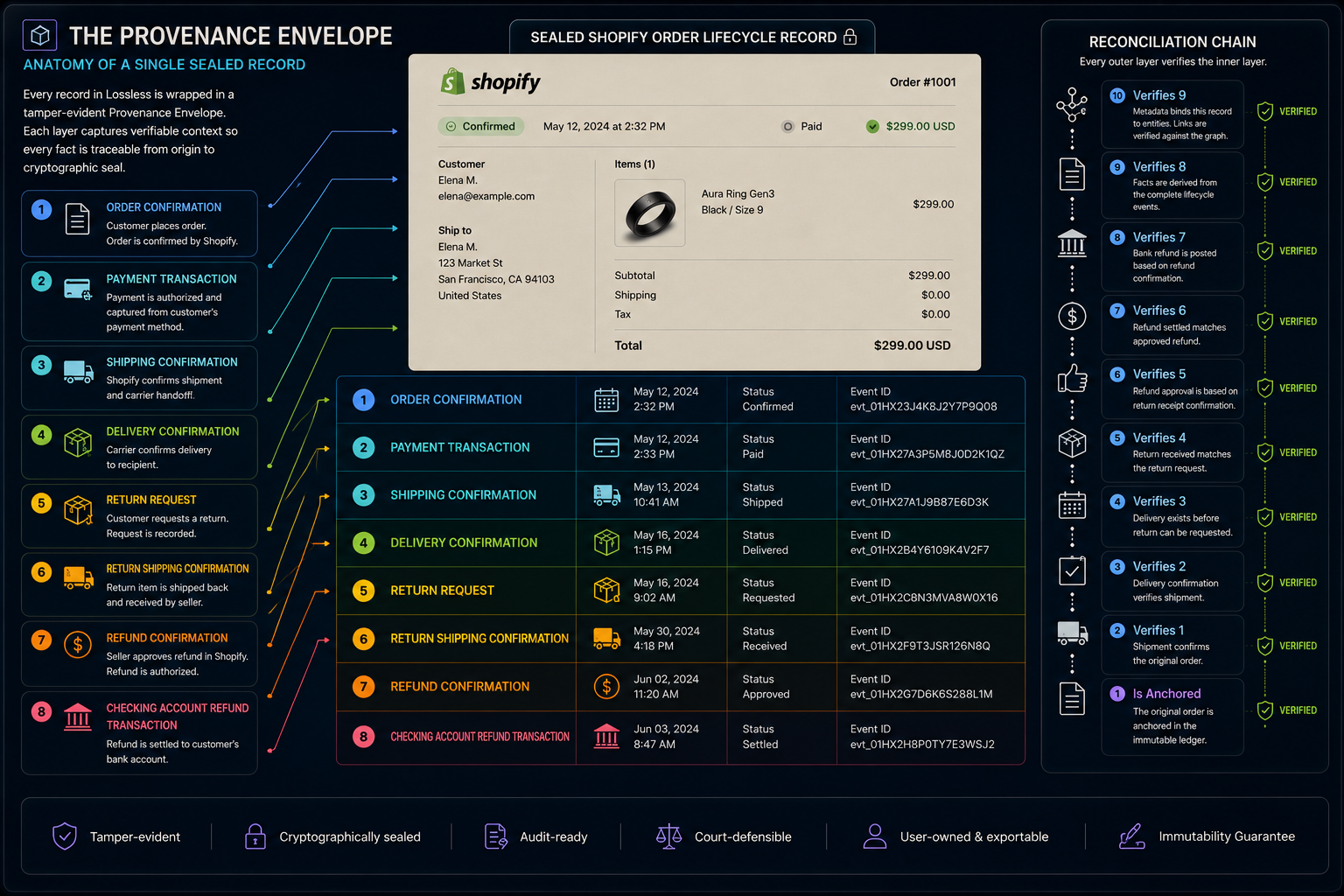
A single Shopify order, expanded. Seven lifecycle events. Each one sealed at ingestion, each one chained to the next, each one independently verifiable. This is what one record looks like inside the Provenance Ledger. There are a hundred thousand of them in a typical Lossless account.
A Provenance Ledger is an append-only store of atomic, typed records — each one signed at ingestion with the source pointer, the parser version, the user's consent scope, and a cryptographic seal. Records are chained through their lifecycle (an order → payment → shipment → return → refund are linked, not orphaned rows). The ledger is bi-temporal: amendments don't overwrite history, they extend it. Every read is audit-logged. Every export carries the signatures with it. Re-verify the chain ten years from now and it still holds.
This is the layer beneath every Lossless surface — Records, Chronology, Chat, Voice, the Agent API, every Workspace. When we say a Lossless answer is grounded, we mean it cites a row in the Provenance Ledger. No row, no answer.
Mutate any sealed record by a single byte and the signature fails. We don't trust the storage layer, the cloud provider, or our own future selves — the math does the trusting.
Ed25519 signature over canonical JSON at ingestion. Content-addressed storage. Per-tenant signing key. The seal is computed once and travels with the record forever.
Every read, every write, every agent call writes an audit row. "Who saw what, when" is a query — not a forensic project. Export the audit log to your CPA, your lawyer, your auditor in one click.
Bi-temporal model (occurred-at and known-at) plus signed chain means the ledger reconstructs to "as of any date X" — the bar for discovery, FRE 902(14) self-authentication, and forensic accounting.
Your signing key, your bucket, your namespace. Export the entire ledger as a signed bundle whenever you want — Lossless going dark tomorrow cannot strand a single record of yours.
Append-only. Corrections become new versioned records that reference what they amend — they never overwrite. The original is still there, still signed, still queryable as of any prior date.
"Memory" is a vector database with no source. "Knowledge base" is a wiki nobody updates. "Audit log" is a write-only file nobody can read across. None of those words capture what we built — so we named it.
The same six guarantees, six different shapes of value. Each Workspace uses the ledger as its evidentiary backbone — the thing the IRS, the opposing counsel, the auditor, or the agent on the other end of the API will accept without argument.
Hand your CPA a signed bundle, not a shoebox. Every deduction maps to a sealed receipt, every K-1 to its source statement, every Schedule E line to the lease and the payout that backs it. Audit risk drops because the math is reproducible from the ledger.
Divorce discovery normally costs $15–60K in forensic accountant hours reconstructing transactions across years of statements, email, and Venmo. The Provenance Ledger already is that reconstruction — chained, dated, signed, and self-authenticating under FRE 902(14).
Every rent collection, every CapEx receipt, every depreciation schedule, every tenant communication chained to the unit. When the tax-time question is "where's the documentation for this $4,800 roof repair," the ledger has the receipt, the contractor's invoice, the bank charge, and the message that authorized it — sealed, dated, exportable.
Communications, exchanges, transfers, and missed-pickups become sealed records the moment they enter the account. Build a child-support recomputation, a custody-calendar reconstruction, or a marital-agreement timeline straight from the ledger. The other side's lawyer cannot argue with the seal.
The defense version of forensic accounting: cell tower pings, charges, tolls, calendar entries, ride-share trips, and messages chained into a sealed, dated reconstruction of where someone was and what they did. Discovery becomes proactive, not reactive.
Juvenile matters span years and switch hands across attorneys, GALs, and courts. The ledger is the continuity — sealed records, audit log, and export bundle survive any change of counsel. The next attorney inherits an authenticated history, not a folder of PDFs.
Every API call, model invocation, vendor charge, and reimbursement request enters the Provenance Ledger sealed and chained. When you dispute a vendor charge, claim a R&D tax credit, or reconcile agent-driven spend across LLM providers, you don't argue with a screenshot — you produce a sealed bundle.
HNW finances live across LLCs, trusts, brokerage, real estate, and entity-to-entity transfers. The Provenance Ledger lets the CPA query across the whole estate without trusting a bookkeeper's spreadsheet. Every cross-entity transfer is a chained, sealed record on both sides.
The graphic at the top of this page is one Shopify order, expanded. Here's what each part of the envelope means in plain English — and why we built it this way instead of just storing a JSON blob.
"Every other AI tool is a black box that promises a good answer. Lossless is a glass box that proves it."
— Beta user · forensic CPA
Now that you've seen what gets sealed, see what we seal — the atomic unit, the schema, the typed payload. Or jump to the back of the pipeline and see how the seal is verified at read time.